
What Is Copywriting?
Copywriting is the craft of writing text that persuades readers to take action. It’s at the heart of marketing and advertising, appearing everywhere from websites to social media ads. The ultimate goal of copywriting is to influence and inspire action, whether that’s clicking, buying, subscribing, or signing up.
A good piece of copy captures attention quickly and speaks directly to the audience's needs or desires. It’s concise and benefit-driven, ensuring every word contributes to moving the reader closer to the intended action.
Where Copywriting Is Used
- Social Media Ads: Short captions designed to grab attention and drive clicks.
- Email Campaigns: Personalized content that nurtures leads or announces offers.
- Websites: Landing pages, headlines, and product descriptions optimized for conversions.
- Search Engine Ads: Compact and impactful content for platforms like Google Ads.
- Sales Pages: Long-form copy designed to persuade through a blend of storytelling and logic.
Copywriting is everywhere, but its effectiveness depends on how well it resonates with the target audience.
Characteristics of Great Copy
Effective copywriting is about delivering value and clarity.
- Focuses on benefits: Instead of describing features, it explains why the product or service matters to the audience.
- Is actionable: Strong calls-to-action (CTAs) like “Shop Now” or “Sign Up Today” encourage immediate engagement.
- Appeals to emotions: Whether it’s curiosity, trust, or urgency, the best copy connects with feelings to motivate action.
For example, instead of saying, "We provide high-quality streaming services," compelling copy might read, "Binge your favorite shows anytime, anywhere—start your free trial today!"

What Is Scriptwriting?
Scriptwriting, unlike copywriting, focuses on crafting content for visual and auditory mediums. It’s the foundation of videos, commercials, podcasts, and movies. While copywriting persuades through text, scriptwriting relies on a combination of words, visuals, and sound to tell stories or deliver messages.
Great scripts immerse the audience in a narrative, creating emotional connections that stay with them long after the content ends. Whether it’s a commercial, explainer video, or feature film, the power of scriptwriting lies in its ability to evoke emotions and deliver clear takeaways.
Where Scriptwriting Is Used
- Commercials: Short and impactful scripts for TV, YouTube, or social media ads.
- Explainer Videos: Narratives that break down complex ideas into relatable concepts.
- Podcasts: Structured storytelling or conversational scripts that guide episodes
- Films and TV Shows: Character-driven stories with dynamic dialogue and plot development.
- Corporate Videos: Training videos, promotional content, or CEO announcements.
Overlaps Between Copywriting and Scriptwriting
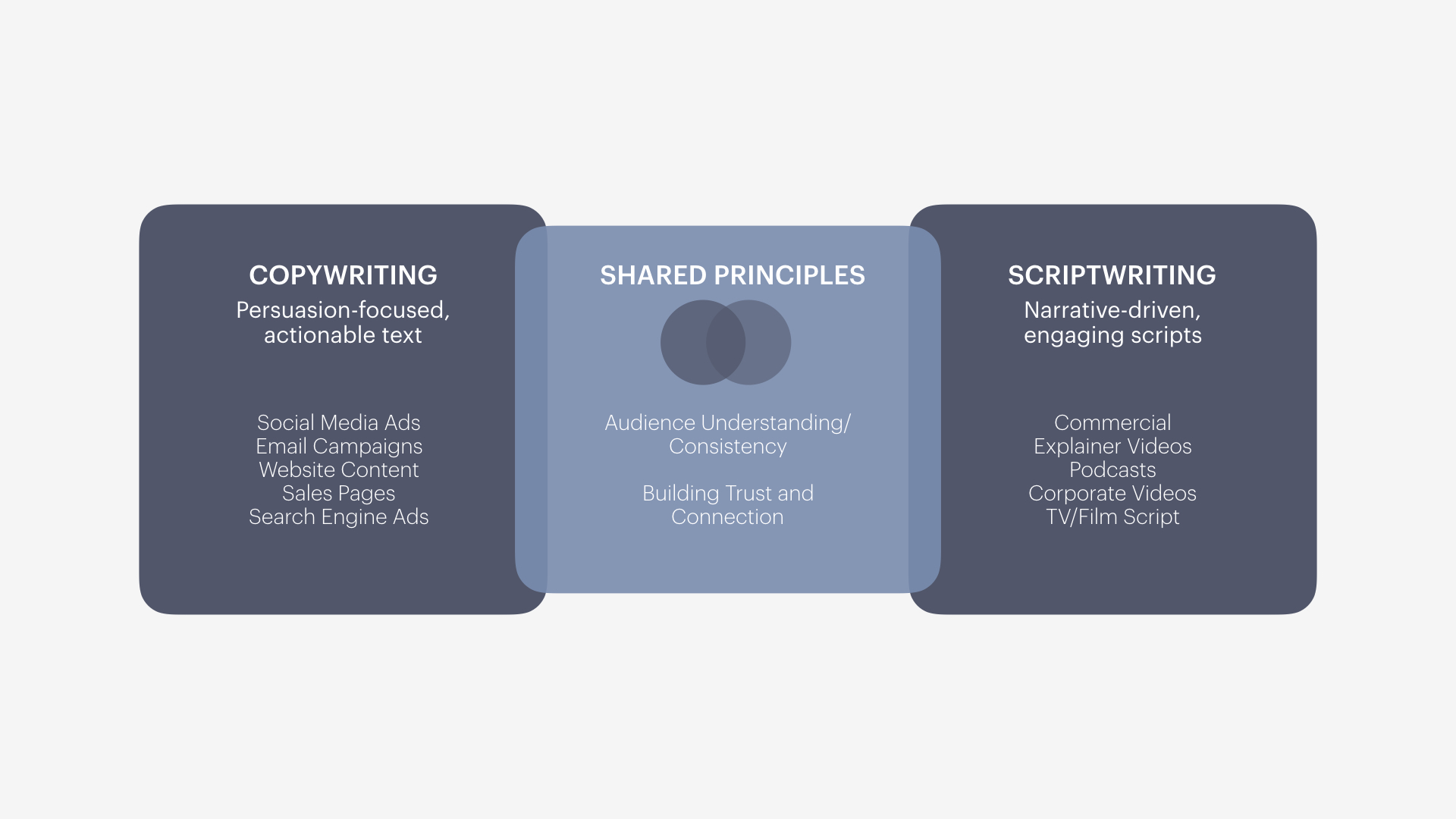
While their purposes differ, copywriting and scriptwriting share many similarities, particularly when it comes to understanding the audience and crafting impactful messaging. At their core, both disciplines require the writer to connect with the audience on a meaningful level.
To succeed in either, a deep understanding of the target audience is essential. Knowing who you’re speaking to, what motivates them, and how they consume content will shape the tone, style, and format of your writing. Without this knowledge, even the most creative ideas risk falling flat.
Another shared principle is the need for consistency. Both copy and scripts must align with the brand’s voice and values. Whether it’s a social media ad or a promotional video, maintaining a unified tone ensures credibility and builds trust. For instance, a luxury fashion brand would use polished, aspirational language across both mediums, while a casual tech startup might rely on playful and relatable content.
Let’s consider a fitness app. If you were tasked with promoting the same product using both copy and scriptwriting, your approach would differ but remain complementary. For written copy, you might focus on the app’s immediate benefits: "Achieve your fitness goals with personalized workouts and progress tracking. Sign up today!" This approach is concise and geared toward inspiring immediate action.
For a promotional video, the script might showcase a day in the life of a user, illustrating how the app helps them stay active and organized. You could depict a busy professional balancing work and health, with the narrator saying, "Your fitness journey is unique—let our app guide you to success, one step at a time." The visuals and storytelling bring the message to life, appealing to emotions and making the app more relatable.
By combining these approaches, you deliver a cohesive message that resonates across multiple platforms.
Tips for Writing Great Copy
Mastering copywriting requires practice and strategy. Great copy grabs attention, resonates with the audience, and drives action. Here’s how to write compelling content:
Understand Your Audience
The best copy speaks directly to the audience’s needs, challenges, and desires. Research their demographics, behaviors, and pain points. Use conversational language that matches their tone, avoiding unnecessary jargon. For example, if your audience is fitness enthusiasts, focus on goals like “getting stronger” or “staying active.”
Highlight Benefits, Not Features
While features explain what a product does, benefits focus on what it does for the user. For instance:
- Feature: "Tracks calories and steps."
- Benefit: "Stay in control of your fitness goals effortlessly."
Benefits connect emotionally, showing the reader how the product will improve their life.
Be Clear and Concise
Keep your copy easy to skim. Avoid long-winded explanations or complex language. Short sentences, simple words, and clear formatting help your message stand out. For example:
- Instead of: “This advanced tool facilitates a seamless integration process,” write: “Easily connect your tools—no hassle.”
Use Power Words
Power words evoke emotion and inspire action. Use terms like “proven,” “free,” and “limited time” to build trust, urgency, and excitement. Instead of generic phrases like “Try it,” say, “Unlock your potential today.”
Include Strong CTAs
A call-to-action (CTA) tells your reader what to do next. Keep it clear and actionable, such as:
- “Start your free trial today.”
- “Shop the collection now.”
- “Book your consultation in one click.”
Adding urgency—“Limited time offer!”—further motivates readers to act quickly.
Tips for Writing Engaging Scripts
Writing scripts requires a balance of storytelling and structure. Here’s how to create scripts that captivate your audience:
Start with a Hook
Grab attention within the first 10 seconds. Use a bold statement, a surprising fact, or a relatable question, such as:
- “What if you could achieve your fitness goals in just 10 minutes a day?”
Starting strong ensures your audience stays engaged.
Write for the Ear
Scripts are meant to be spoken. Avoid overly formal or long-winded sentences. Read your script aloud to ensure it flows naturally. For example:
- Instead of: “Our advanced features streamline processes efficiently,” say: “Get things done faster and easier—without the headaches.”
Build a Clear Narrative
Every script needs a beginning, middle, and end:
- Beginning: Introduce a problem or grab attention.
- Middle: Showcase your solution or tell your story.
- End: Close with a resolution or strong CTA.
A script for a productivity app might start with the problem (“Too many tasks?”), highlight the app’s features, and end with: “Download the app today.”
Leverage Visuals
Pair your script with visuals or sound. For example, animations can illustrate a product feature, or live-action scenes can bring a story to life. Collaborate with designers or producers to align words with visuals.
Evoke Emotion
Emotion is key to making your script memorable. Use relatable scenarios, inspiring language, or even humor to connect with your audience. A charitable organization might share a heartfelt story to inspire action, while a tech company could use humor to make their brand approachable.
Bridging Copywriting and Scriptwriting
Copywriting and scriptwriting often overlap in modern campaigns. A social media ad might pair written copy with a short video, and product descriptions might inspire explainer videos. Collaboration is key to ensuring consistency across formats.
To align the two, maintain the same tone and message. For example, if your copy emphasizes trust and reliability, the corresponding script should visually and narratively reinforce those ideas. By working cohesively, these two disciplines can amplify each other’s effectiveness.
Copywriting and scriptwriting are indispensable tools for engaging audiences and driving results. Copywriting persuades through concise, action-driven text, while scriptwriting builds emotional connections through storytelling. Together, they form the foundation of modern communication strategies.
By mastering both, you’ll become a versatile communicator capable of crafting content that sells, inspires, and resonates. Start by experimenting—write an ad for a product you love or draft a short script for a hypothetical commercial. Remember, every word is an opportunity to make an impact.